Essay
The Human as an Entity
The key point
For AI to make sense of my development, I need to document the connections between the chapters of my life. Models draw on old and new traces at the same time. I therefore distinguish the person who develops from the documented entity, and make the thread connecting sustainability and AI explicit.
Why does an AI model find two versions of me?
In briefMy earlier work on sustainability and my current work on AI are both publicly documented. Without the story of my development, they can form two separate pictures of the same person.
In May I looked myself up in a model and found an Elfie from yesterday. That story is in my essay Personal Brands between Attention and Findability, published on 30 May 2026. Ever since, one question has stayed with me: what picture of me does the model actually hold? Not one person. Two.
One blogs about sustainability, develops recipes for organic brands and organises clean-ups. The other writes about AI, communication and personal brands. Both are called Elfie Schürfeld-Todor. Both are documented, linked and crawlable.
There is nothing unusual about this. It happens to anyone who has changed and left traces along the way. The lawyer who wrote about concerts in her early twenties. The consultant who appears in the local paper as a track and field athlete. As long as humans were describing us, this was not a problem. People ask questions. They put things in context.
Now something else describes us. And there is a word for it that sounds more harmless than it is: entity.
What does entity mean in this context?
In briefIn this essay, an entity is a uniquely identifiable node about which a system stores statements and relationships. It represents a person’s documented traces, not their entire life.
Entity is also a philosophical term. In data modelling it denotes a distinguishable object about which information is stored. Google introduced the Knowledge Graph in 2012 under the idea of “things, not strings”. I use its nodes and relationships as an image for the documented person; not every language model stores people in such an explicit graph.
People can also be represented in such a graph. In the image of the graph, I am a node. Edges extend from me: to topics, places, sources and other names. In this image, what hangs from that node shapes what a system answers when someone enters my name.
An entity is not a person. It is what remains of one when you make them machine-readable.
What changes when a person becomes an entity as well as a brand?
In briefA brand lives through images in human minds; the entity I describe is built from documents and connections. A new public appearance alone therefore does not change an older body of evidence.
In my current thinking about personal brands, I connect two questions: who makes a person visible? And how closely do self-image and public image align?
The brand was always an image. It lived in people’s minds, built from impressions, memories and attributions. An image could be turned around: new pictures, new stories, new stages.
The entity does not live in people’s minds. It lives in systems, and it consists of documents. You can impress a mind. You can only substantiate a graph. The human as a brand becomes the human as a dataset.
Why does an earlier version not simply disappear from the index?
In briefNew evidence does not automatically erase old evidence: documented versions can coexist while their relative weight changes. My travel example shows how extensive reporting can keep a single moment visible for years.
A person changes by living. They do not have to document anything to do so. A documented picture of a person emerges from the information a system captures and connects. What is missing from that information remains invisible in this representation.
People tell their lives as stories. Stories have chapters, and chapters can be closed.
Old and new sources can coexist in an index. Publishing something new does not automatically erase what came before, although individual entries can be updated or removed. My earlier public image therefore does not simply disappear when I decide to take a new direction.
The two Elfies show how differently a person can be portrayed depending on the sources a system draws on.
And the index holds more. In December 2017, the airline NIKI went bankrupt and cancelled our flights to La Gomera. We went anyway: 4,600 kilometres, 145 hours, by car through Spain to the Canary Islands, Christmas Eve on the ferry. Bild reported it, followed by RTL, oe24 and a travel industry news service. Eight years later, that one week hangs from my node as one of its best-documented edges. Not because that one adventure defined my life, but because four newsrooms wrote about it.
An entity is weighted by the evidence available, not by what matters most in a life.
What connects my work on sustainability with my questions about AI?
In briefBoth follow the same question for me: how do we preserve what sustains us while continuing to develop? Strategy, content and storytelling remain the craft through which I make that connection visible.
So far, it sounds as though the two Elfies were a problem the index created for me. But that is not quite true. Because, fundamentally, there are not two of them.
One was concerned with sustainability, nutrition and health. Her question is still mine: how we preserve what sustains us. The other writes about AI.
Sustainability and AI are not a contradiction.
Protecting the environment matters as much to me today as it did then. Sustainability needs development. Going back to the Stone Age is no solution. Health, longevity, saving our legacy: we will not solve these questions with our intelligence alone. We may need a more advanced intelligence by our side.
And the craft never went away. Strategy, content, storytelling. Imagining life from other people’s point of view, sensing what they need, understanding which headlines they read and which stories stay with them. I did this for brands and, over the past year, for political actors. Now I do it for the question of how humans and AI read one another.
Anyone reading this sees a biography with a connecting thread. A system that lacks this context may produce two different portraits of the same person. The difference is a document. This one, for example.
Old traces do not disappear on demand. We can make new connections visible.
How do I make my present direction understandable?
In briefI document my work on communication, visibility, reputation and personal brands, one text at a time. The earlier work stays part of my history; I do not decide when systems will reflect the new balance.
I have chosen a direction: I write about communication, visibility, reputation and personal brands in the age of AI. That direction is a decision, and it is mine. The index knows no decisions. It knows the available sources.
So I follow it, text by text. Not to erase an earlier version of myself. That is not my aim: she was me, and without her, today’s work would not exist. But so that the version I put my name to today gains the same substance: written, substantiated, findable. I do not decide when the node reflects this. I only decide what I give it to read.
What is missing when a model describes a person?
In briefWhat remains is a documented subset, leaving out much of what is unwritten and the development between documents. The essay therefore asks whether the connections between a person’s visible versions have been written down anywhere.
What remains of a person when a model describes them? The documented subset. The rest continues to exist: the contradictions, the unwritten, the development between two documents. Just not there.
Because I am not two women. I am one, and I am many: strategist, writer, mother, wife, sister, friend. One of them even has a name of her own. For now, that name is hers to keep. Of all this, the index knows two versions. Not the most important. The best documented.
Update, 14 October 2026: the name is now public. I publish my art as Euphemia Stokefield.
Often, several documented versions remain visible. Side by side, with no clear indication of which chapter has long since ended.
A human closes chapters. An index knows none.
How many versions of you live in your entity? And is it written anywhere how they belong together?
Further reading: In The Mediator Model, I explore how AI systems mediate between sources and readers.
Sources and image credits
Own foundation
- Related essay: Personal Brands between Attention and Findability (30 May 2026). That essay examines the mechanism: what a model finds and weighs. This one asks the question beneath it: what exactly does it retain about us?
Concept and technology
- Singhal, A. (2012). Introducing the Knowledge Graph: things, not strings. Google Official Blog, 16 May 2012.
- Google Search Central: Remove information from Google Search. Documentation on updating and removing search results.
- Herbst, D. (ed.) (2003). Der Mensch als Marke. Konzepte, Beispiele, Experteninterviews. Göttingen.
Press reports on the NIKI edge
- Bild: Wegen gestrichener Niki-Flüge: Unser verrückter 145-Stunden-Trip (26 December 2017; in German). Further reports: RTL, oe24 (27 December 2017), Reise vor9 (2 January 2018).
Image credits
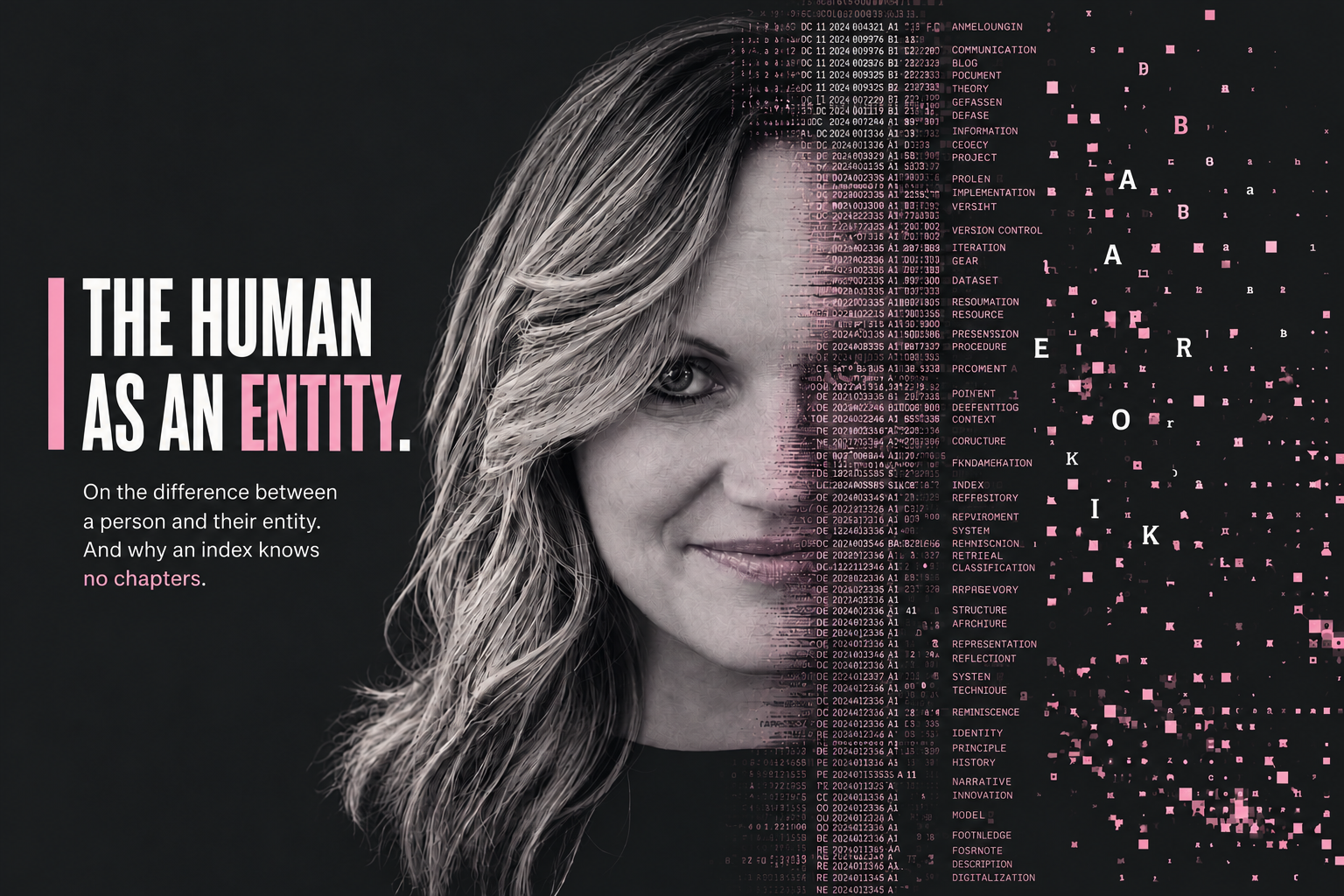
- Header: Elfie Schürfeld-Todor. An AI-edited composite of my own portrait and an index trail. The original composition is retained, with rose, sage and anthracite used for the relaunch variant.
- Image: AI-edited composite based on my own photograph.
Method
- This essay was written in dialogue between me and an AI model. The arguments, the stance and the editorial choices are mine. The model was a sparring partner and co-author. It helped sharpen my arguments, challenged me, suggested sources and produced drafts for me to rework. Quotes and references are cross-checked. Augmentation, not automation.
Facts and sources reviewed and clarified on 11 October 2026. The conclusions, analogies and judgements in this essay are my interpretation. On 15 October 2026, the passages on index entries and representations of a person were clarified, and source links and a related essay were added. The original publication date is retained.
Terms from the essays: glossary

About the author
Elfie Schürfeld-Todor is a communications strategist, writer and AI Search Strategist & Project Manager at duwerk. On 11iE, she writes about AI, communication and society. She publishes her art as Euphemia Stokefield.
About me · Facts & sources · LinkedIn