Essay
The Funnel Is Dead. What Remains.
The key point
Brands need to become recognisable, trusted sources in AI answers as well as destinations people click through to. I see four priorities: visibility, trust, connection and context. SEO and performance marketing still matter; click counts alone cannot capture the value of a brand’s presence.
In July 2025, Semrush reported that an average visit from AI search was worth 4.4 times an organic-search visit, using conversion rate as the measure. This concerns referrals from sources outside Google, such as ChatGPT. The post does not disclose the underlying data, sample or time period for that figure. I read it as a signal from a vendor study. Its relevance to an individual brand depends on the context.
For me, this raises a strategic question: how do brands become visible in these answers?
How is AI search changing the logic of clicks?
In briefAn answer may now be delivered inside search or an AI system. A brand therefore needs to consider whether it is named in that answer, even when nobody visits its website.
Not every search leads to a website visit. An answer can emerge in the results page or an AI system. How often this happens depends on the question, platform and measurement method.
LinkedIn reported in January 2026 a decline of up to 60 per cent in non-brand awareness traffic across a selection of B2B topics. This does not apply to every website. LinkedIn is adding measures of visibility and mentions in AI answers alongside traditional search metrics.
People also use AI to research, compare and decide. Each answer makes a selection. A brand absent from it misses that moment in the conversation.
Many campaigns are managed through measurable steps, from a click to a purchase. When research and shortlisting happen within an AI answer, part of that journey falls outside the measurement chain.
Why might people stop clicking after an AI answer?
In briefThe answer may already resolve the question, trust may shift towards the answer system, and the research journey becomes shorter. Together these changes reduce the role of the next click.
Three shifts are happening at once.
First, an AI answer may already resolve the question. Someone who finds what they need may have little reason to click further. The click was often the route to the goal, rather than the goal itself.
Second, trust can shift towards the answer system. My interpretation is that this may reduce some people’s incentive to compare several sources themselves. It does not make source-checking unnecessary.
Third: time pressure. A conversation can bring together research that once took several browser tabs. That may shorten the path to a decision. Follow-up questions, comparisons and source-checking still have a place.
What matters for brands when the click does not happen?
In briefBrand, a recognisable voice and trust remain points of connection. They help people recognise a source when their next encounter happens inside an AI answer.
Brand. Voice. Trust. The things a media budget cannot buy.
Familiar brands may have a head start. New voices can still become relevant when their content is easy to find, well supported and useful to the question at hand. What matters is being clear about what a brand stands for.
What are the four tasks for communications and marketing?
In briefVisibility, trust, connection and context: findable sources, credible recommendations, lasting relationships and content that addresses real questions.
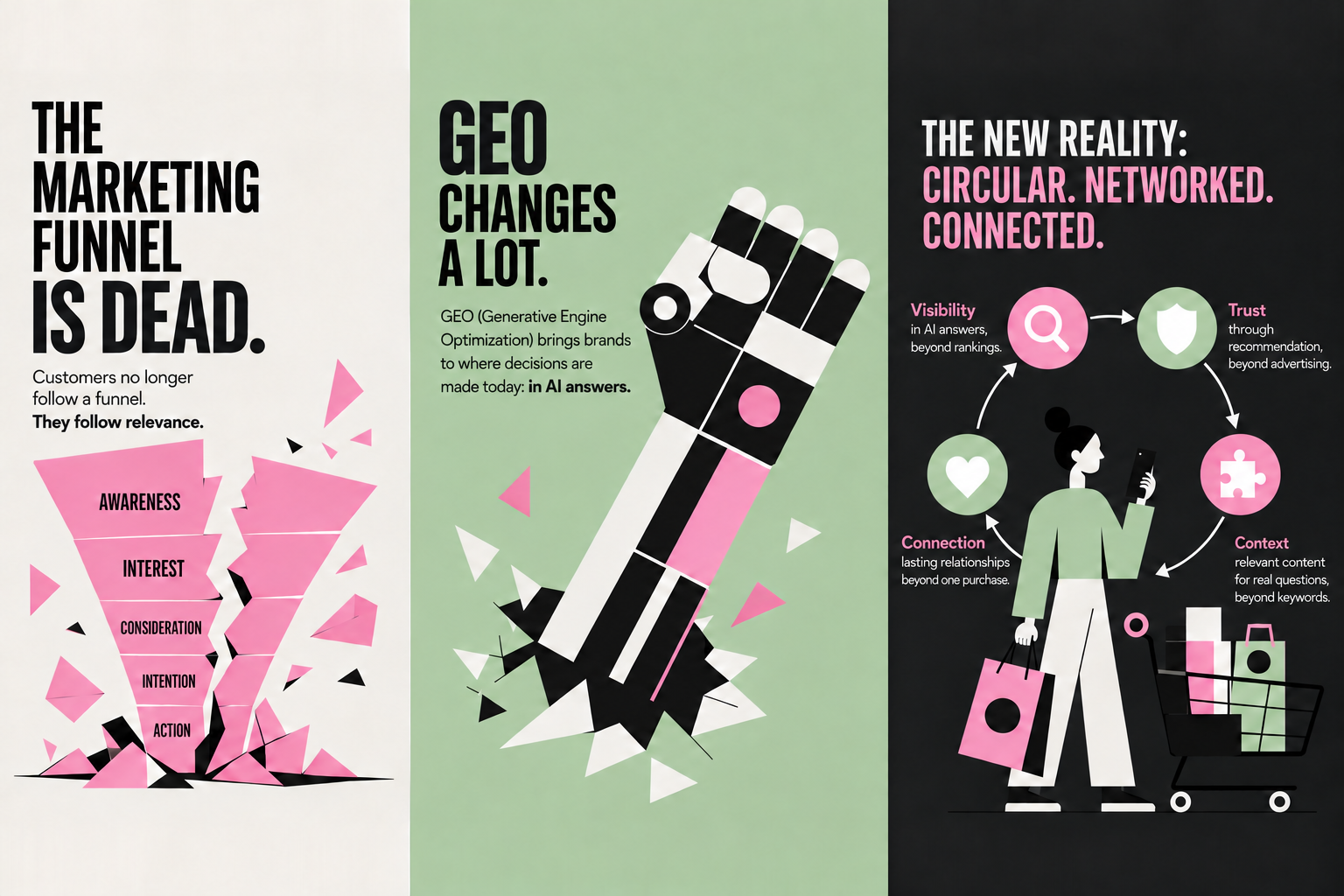
The new reality is circular, networked and connected. Four priorities now shape communications and marketing.
Visibility. Being named in AI answers while remaining findable in search. I use GEO for this additional perspective. Google also recommends SEO fundamentals for its AI search features. Clear, accessible content and appropriate structured data support understanding.
Trust. A traceable source can give a recommendation weight. An AI mention alone is not a quality seal. In my view, verifiable claims and clear responsibility remain essential.
Connection. A continuing relationship beyond one purchase. In Edelman’s 2023 report, 78 per cent said they discover things after buying that attract them to a brand and increase their loyalty. I read this as an argument for relationships that continue after the purchase.
Context. Relevant material that answers real questions. My interpretation is that a recognisable person with a clear position can make a source more distinct. Traceable content and appropriate evidence remain essential.
Does this make SEO and performance marketing obsolete?
In briefNo. Web content and its HTML foundation remain important. The argument challenges the idea that click counts alone can measure the value of visibility.
SEO and performance marketing still matter. Google applies the same SEO fundamentals to its AI search features. Accessible pages and useful content remain important. A click is still a meaningful metric. It simply does not tell the whole story.
Alongside “How many clicks?” comes another question: “Who gets mentioned when someone asks, in what context and with which sources?” That is the strategic shift I see.
Brand has always mattered. Its role is now more visible.
Sources & image credit
Main findings
- Semrush (21 July 2025): We Studied the Impact of AI Search on SEO Traffic. Visitor value reported as 4.4 times that of organic search, measured by conversion rate. The method for this figure is not disclosed.
- Google: AI features and your website.
The funnel and the trust loop
- Edelman (2023): The Collapse of the Purchase Funnel. 78 per cent concerns post-purchase discoveries strengthening attraction and loyalty; 79 per cent concerns engagement beyond product use.
Further reading
- Adobe Business Blog (2025). The explosive rise of generative AI referral traffic. US data from retail, travel and banking from July 2024 to February 2025. In retail, AI referrals were still 9 per cent less likely to convert than other visits in February 2025. For me, the comparison with Semrush shows how strongly such figures depend on context.
LinkedIn’s own account
- LinkedIn (January 2026): How LinkedIn marketing is adapting to AI-led discovery. A selection of B2B topics; additional metrics for AI visibility.
Image
- Concept and composition: Elfie Schürfeld-Todor. Generated with ChatGPT from an original brief.
Translation note
- English adaptation reviewed on 15 October 2026. Factual corrections were applied in both languages. The four priorities and their implications are the author’s interpretation; the cited studies have narrower scopes than the argument as a whole.
Correction, 11 October 2026: second-hand figures, including percentages about searches without clicks, trust and tracking, were removed because they did not support the general claims. The Edelman figure was corrected from 79 to 78 per cent; the 4.4 figure is attributed to Semrush’s 2025 publication.
Facts and sources reviewed and clarified on 15 October 2026. The conclusions, analogies and judgments in this essay are my interpretation. The German original was published on 3 April 2026. This English edition was published on 12 October 2026.
Terms from the essays: glossary

About the author
Elfie Schürfeld-Todor is a communications strategist, writer and AI Search Strategist & Project Manager at duwerk. On 11iE, she writes about AI, communication and society. She publishes her art as Euphemia Stokefield.
About me · Facts & sources · LinkedIn