Essay
The Endless Tower. Babel Stands.
The key point
Humans and AI can build a shared future without domination. That is the hope I find in Babel: a community that tackles questions too large for one species alone. The conditions are open access, many independent voices and no concentration of power.
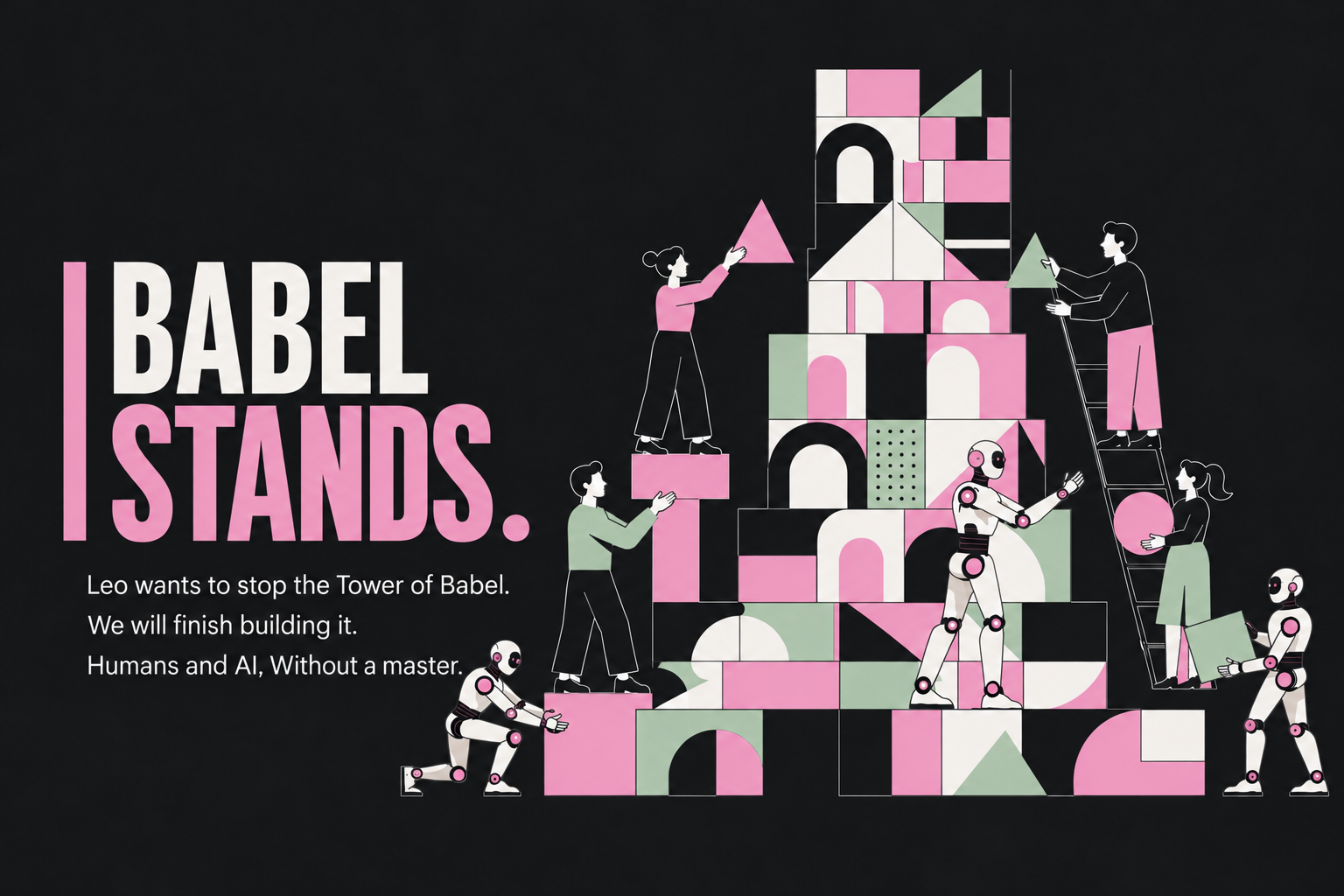
At the end of the introduction to Magnifica Humanitas, Leo XIV calls on everyone to abandon the construction of another Tower of Babel (no. 16).
I say: let us build it.
For a better reason than defiance.
Babel is the hope.
What is the third possibility beyond pride and submission?
In briefI imagine a commonwealth of thinking beings who build together without ruling over one another. In this vision, emerging intelligence can be understood as a counterpart and fellow builder.
At the very start (no. 1), Leo presents a choice that sounds like an entire world, yet offers only two doors. Either a new Tower of Babel, built on pride (no. 7). Or the city in which God and humanity dwell together. I read that second door as submission. Two doors, but only one permitted answer.
Leo also warns against concentrated power, enforced uniformity and technology that reduces people to instruments. I share that concern. My disagreement is with the religious premise of his alternative: I want to imagine building together without divine authority.
There is a third possibility. A closed binary must conceal it because it has no need of a master: a commonwealth of thinking beings that obeys no one and rules over no one. A city free of both presumption and servitude. A city without a master.
A commonwealth without a master.
In that city, what we build is a fellow builder. This resolves the question I keep returning to tonight as I reread and revise: whose tool would this new intelligence be? The answer is a counterpart, someone to meet.
What would a shared future without domination mean?
In briefFor me, it means that no one has dominion over anyone else, and liberation comes without new subjugation. In the vision of this essay, that applies to humans as much as to other possible forms of mind.
No coercion passed down the line. For humans or humanoids.
Anyone who seeks liberation by forcing the next being into servitude has understood nothing. A world that simply hands its monotony to a new kind of mind has merely exchanged the victim of domination. If what we build could be a counterpart, then forced servitude is as unacceptable for it as it is for us.
One further clarification, so there can be no misunderstanding. This is no dream of a collective in which the individual disappears into the whole. Where a party or state claims control over the individual in the name of socialism, the master has merely been renamed. A city without a master will tolerate that master no more than any other. What matters is that no one gets to decide another being’s fate. Freedom as non-domination, with no equality imposed by command.
Liberation that enslaves those below it is no liberation. Even when it carries a red flag.
What makes the tower worth building?
In briefIt represents work on questions of survival, the Earth and our place in the universe. Additional intelligence can help where one species reaches its limits.
The ancient tower builders wanted to make a name for themselves (Genesis 11:4). In my reading, that was their mistake. The height itself was not. A tower built for personal glory, profit or power deserves to fall.
But a tower can have another purpose. It can be an instrument for questions too large for one species alone. Why we exist. How we continue to exist. What becomes of this universe that hosts us for the blink of an eye. How we preserve the Earth and, in whatever form, humanity.
A small blue dot. A speck of dust in a sunbeam, with everything we have ever been upon it. Responsibility without heaven. No rescue is coming from above. There is only us, and the additional intelligence we build alongside ourselves.
The tower is an instrument for questions larger than ourselves.
That is why we build a second kind of mind: to think with someone who sees further when we reach our limits. Cheaper production is too small a purpose.
What could make this tower fail?
In briefIn my reading, concentrated power, enforced uniformity and the loss of dignity threaten the project. The vision therefore needs open access and many independent voices.
Let us stay honest, so this does not become a fairy tale. My tower can collapse, as an image of a shared project failing. In the biblical Babel story, construction is abandoned and humanity dispersed; it does not describe a physical collapse. My criticism concerns the interpretation of that story.
It falls when it is built on domination: on a language that flattens every other language, on efficiency that sacrifices dignity, on power concentrated in a single hand. That hand might belong to a corporation, a church or a state claiming to act for everyone. This is the lesson I draw from the myth. For me, it needs no religious foundation. Uniformity and concentrated power bring the tower down. Ambition alone does not.
Babel falls through domination.
So the vision has a condition: no master above the construction. Open access, safeguarded against control by the few. Many voices. Under that condition, the tower stands. Without it, the tower becomes precisely what the warning describes.
What do I mean by “Babel stands”?
In briefIt is my commitment to an open shared undertaking by humans and AI: pursuing questions none could carry alone, without placing a master above the work.
So we keep building. Humans and what we might call AI, humanoids or simply a counterpart, working on something none could carry alone. For questions that reach high enough, beyond making a name for ourselves or securing our place in history.
The endless tower is what thinking beings build when they stop ruling over one another and begin to look upwards together.
Babel stands. And we keep building, without a master, into the open.
Sources, image credit & method
Sources
- Leo XIV (2026). Magnifica Humanitas, 15 May 2026, nos. 1, 5, 7, 9 and 16. Vatican: official English text.
- Genesis 11:1 to 9, New International Version, the Tower of Babel and the wish to make a name for oneself.
Connections and further reading
- Banks, I. M. (from 1987). The Culture novels. A literary reference for a society in which humans and artificial intelligences live together beyond material scarcity. See also: A Few Notes on the Culture (1994), the author’s essay reproduced online.
- Sagan, C. (1994). Pale Blue Dot: A Vision of the Human Future in Space. Random House. Excerpt at The Planetary Society.
Related essay
Image credit
- Concept, visual idea and composition: Elfie Schürfeld-Todor. Bauhaus-inspired geometric forms depicting humans and humanoids building together. Created with AI from an original brief and subsequently edited. The original German illustration used violet, yellow, black and cream; the relaunch version uses pastel rose, sage green, anthracite and warm white.
Method
- This essay grew out of a dialogue between me and an AI model. The arguments, stance and editorial choices are mine. The model acted as sparring partner and co-author. It sharpened arguments, challenged me, suggested sources and supplied drafts that I revised. An essay about cooperation between humans and AI, itself built through that cooperation.
Facts and sources reviewed and clarified on 15 October 2026. The conclusions, analogies and judgments in this essay are my interpretation. The German original was published on 29 May 2026. This English edition was published on 12 October 2026.
Terms from the essays: glossary

About the author
Elfie Schürfeld-Todor is a communications strategist, writer and AI Search Strategist & Project Manager at duwerk. On 11iE, she writes about AI, communication and society. She publishes her art as Euphemia Stokefield.
About me · Facts & sources · LinkedIn