Basics with critical notes
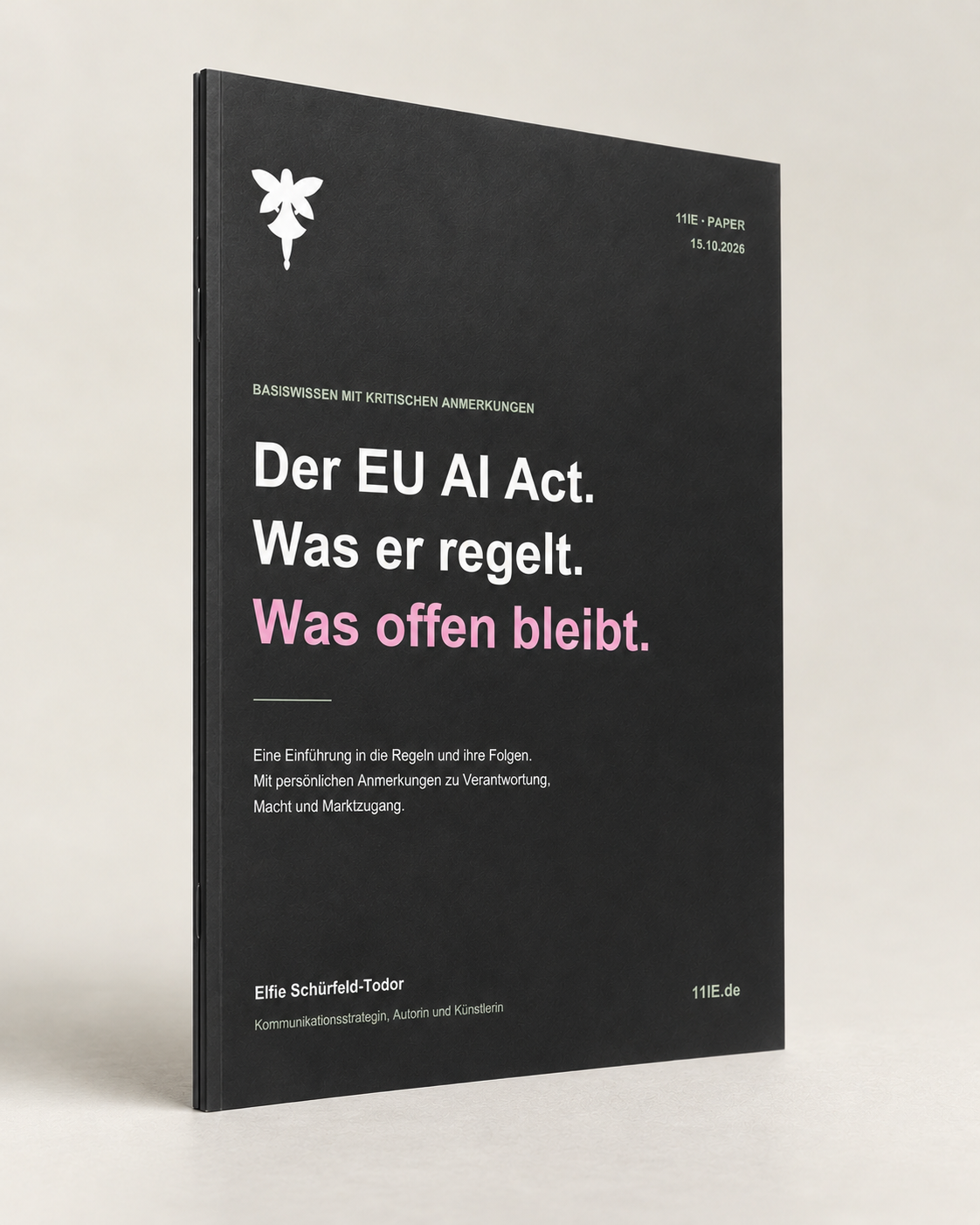
The EU AI Act.
What it regulates.
What remains open.
Which rules apply to artificial intelligence? And which questions does a law leave unanswered? An introduction to the EU AI Act, with my thoughts on responsibility, power and market access.
The full paper is available in German only.This page summarises its five central arguments in English.
Download PDF in GermanFree download. No sign-up. 27 pages · in German · approx. 1.6 MB
Content as of 15 October 2026
What this paper is about
The EU AI Act classifies risks and sets obligations for how artificial intelligence is developed and used. This paper explains its key terms, roles and rules. It is written for people who want to understand what the regulation covers and which questions remain open as it is put into practice.
Its six chapters combine the basics with my personal assessment. The focus is on market access, state exemptions, AI labelling and the question of who carries responsibility. Legal statements are backed by clickable sources. My own assessments are marked as “Meine Einordnung” (my assessment).
Five arguments from the paper
01 · Market access
Equal rules can have unequal effects.
Later revenue does not pay for the upfront work. Small companies have to invest time, expertise and money before their high-risk product earns anything. Large providers spread similar tasks across existing departments and many products.
02 · State power
Oversight has to limit power.
The more powerful the actor, the more independent oversight matters. State AI can affect people who cannot simply opt out of it. Safeguards are only as strong as the institutions that enforce them.
03 · Human contribution
AI becomes visible. Where is the human?
This paper draws on my EU AI Act course, my notes, my questions and my choice of sources. A blanket AI label does not tell that story. It shows that a tool was used, but not what a person contributed. Human work has to stay visible.
04 · Labelling
Transparency needs access to verification.
Whoever marks content also decides who gets to detect the mark. For me, transparency remains incomplete as long as independent verification, understandable error margins and a way to object are missing. A technical signal must not replace a judgement about authorship, performance or credibility.
05 · Product logic
Product logic meets rapid development.
For high-risk AI, the AI Act adopts the product logic that also governs lifts and medical devices. An extended product check is not yet a convincing answer to how fast AI changes. Whether a new model version, new data or a different use still fits the original assessment is for the provider to recognise and justify. In short development cycles, that becomes a permanent review task.
What you will find in the paper
- Risk categories, obligations and deadlines
- Roles, responsibility and high-risk systems
- Transparency, deepfakes and my Viewer Test
- Critical notes on market access, state exemptions and labelling
- A timeline, a diagram and direct links to 32 sources
Sources and status
Edition and source check: 15 October 2026. Editorially revised on 18 October 2026. The PDF contains the full list of sources, with references placed directly at the relevant statements.
The core sources are the AI Act on EUR-Lex and the European Commission’s AI Act Service Desk. The Commission explains the link to EU product law in the New Legislative Framework.
The paper reflects the status stated above. Later changes may not yet be included. Some sections cover the German implementation (KI-MIG, Federal Network Agency) and a German court ruling.
My longer critique of compliance costs and unequal influence on the rules is in the essay “The EU AI Act and the two classes”.
Read and think further
Free PDF download, in German. No sign-up.
I am not a lawyer. This paper provides general information and my personal assessment of the EU AI Act. It is not legal advice and does not replace individual advice from a qualified lawyer.